On this page
💰 Click here to see Vietnam Budget Breakdown
💰 Prices updated: October, 2026. Budget figures are estimates — always verify before travel.
Exchange Rate: $1 USD = ₫25,964.41
Daily Budget (per person)
Shoestring: ₫650,000 – ₫1,550,000 ($25.03 – $59.70)
Mid-range: ₫1,800,000 – ₫3,900,000 ($69.33 – $150.21)
Comfortable: ₫5,200,000 – ₫9,100,000 ($200.27 – $350.48)
Accommodation (per night)
Hostel/guesthouse: ₫120,000 – ₫350,000 ($4.62 – $13.48)
Mid-range hotel: ₫780,000 – ₫1,850,000 ($30.04 – $71.25)
Food (per meal)
Budget meal: ₫60,000.00 ($2.31)
Mid-range meal: ₫250,000.00 ($9.63)
Upscale meal: ₫800,000.00 ($30.81)
Transport
Single metro/bus trip: ₫10,000.00 ($0.39)
Monthly transport pass: ₫300,000.00 ($11.55)
What Bac Ha Market Actually Is
By 2026, Sapa has become so developed that first-time visitors often arrive expecting a remote highland experience and instead find a resort town with traffic jams on weekends. That pressure has pushed more travelers toward Bac Ha, a small town about 65 kilometers east of Lao Cai that hosts one of the most genuine weekly markets in northern Vietnam. Unlike some “cultural markets” that have been tidied up for tourism, Bac Ha on a Sunday morning still functions primarily as a trading hub for the ethnic minority communities who live across the surrounding plateau.
The market runs every Sunday, and Sunday only. It starts filling up from around 6:00 AM and reaches its peak chaos — the good kind — between 8:00 AM and 11:00 AM. By early afternoon, most of the traders have packed up and the streets quiet down almost completely. That single weekly pulse is what gives Bac Ha its character. People here are not performing for visitors. They are buying pigs, arguing over fabric prices, and catching up with neighbors they may not see again for another week.
The market spills across several distinct zones: a covered textile and clothing section, an open-air livestock area on the edge of town, and a dense cluster of food stalls and open-air eateries that crank up the moment the crowds arrive. The whole area covers several blocks and can feel genuinely overwhelming in the first twenty minutes. That feeling fades once you find your footing and stop trying to see everything at once.

Who Comes to Bac Ha Market
The visual impact of Bac Ha is largely down to the Flower Hmong, the dominant ethnic group on the Bac Ha plateau. Their clothing is among the most striking in all of Vietnam — layered skirts in electric blues, greens, and reds, embroidered with geometric patterns that take months to complete. Women often wear headscarves wrapped in bold colors, and the combination against the foggy mountain backdrop creates a scene that does not look real until you are standing in the middle of it.
Beyond the Flower Hmong, you will also find Tay, Nung, Dao, and La Chi people trading at the market. Each group has its own style of dress and its own specialty goods. The Tay women often wear simpler indigo-dyed clothing, while some Dao traders arrive with distinctive red headdresses. This mix of communities in one place on one morning of the week is exactly what makes Bac Ha different from smaller, more homogenous markets elsewhere in the north.
Most of the people at this market have walked or ridden motorbikes from surrounding villages, some of them traveling for over an hour on mountain roads. This is their weekly errand run, social event, and marketplace rolled into one. Children run between stalls. Older women sit in tight circles examining embroidery. Men crowd around the livestock pens, gesturing and negotiating in a mix of local languages. The energy is completely different from anything you will find in a lowland city market.
What to Buy at Bac Ha Market
The textile section is the most visitor-friendly part of Bac Ha. Stalls sell everything from finished embroidered bags and cushion covers to bolts of hand-woven fabric sold by the meter. The quality varies significantly. Mass-produced items imported from China have crept into some stalls over the past few years, so it pays to look closely. Genuine hand-embroidered pieces take time to make and the stitching is dense, even, and usually slightly irregular in the way that handmade things are. Machine-made patterns look too perfect and feel thinner.

Prices at Bac Ha are negotiable but not dramatically so. A small embroidered bag might start at around 80,000–120,000 VND (roughly USD 3–5). A full hand-embroidered skirt panel can run 500,000–1,500,000 VND (USD 20–60) depending on the complexity and the seller’s read of who they are dealing with. Arriving early, being polite, and showing genuine interest in the craft rather than just the price tends to produce better outcomes than aggressive bargaining.
The livestock market is not a shopping destination for most visitors, but it is absolutely worth walking through. Horses, buffalo, and pigs are bought and sold in a pen area on the northern edge of the market. The smell is strong, the ground is muddy, and the noise of animals and traders overlaps into something that feels ancient and entirely removed from modern Vietnam. Even if you buy nothing, it grounds the experience in something real.
Other things you can pick up at Bac Ha include locally produced honey (sold in recycled bottles), dried medicinal herbs, corn wine in unlabeled plastic bottles, and simple agricultural tools. None of these are exotic souvenirs — they are functional goods that local people actually use.
What to Eat and Drink at Bac Ha Market
The food at Bac Ha market is one of its underrated pleasures. Stalls along the main food alley start firing up before 7:00 AM, and the smell of pork broth and wood smoke drifts through the cold mountain air long before the textile vendors have even finished setting up. The signature dish of the area is thang co, a horse meat stew cooked in a large communal pot with organs and spices including star anise and cardamom. It is an acquired taste — rich, slightly gamey, and absolutely not for everyone — but eating a bowl of thang co at a shared table surrounded by Flower Hmong traders is a genuinely different experience from anything you will find in a tourist restaurant.
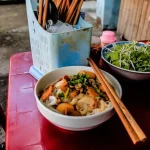
For those less adventurous with their proteins, grilled corn, sticky rice wrapped in banana leaves, and bowls of pho are all available and excellent. There are also stalls selling banh cuon (steamed rice rolls) and fresh-cut fruit. The pho at Bac Ha tends to have a lighter, cleaner broth than the richer versions you find in Hanoi — delicate and warming on a cold morning when the mist is still sitting on the hills around town.
Corn wine — ruou ngo — deserves its own mention. Distilled from fermented corn and brewed locally by Flower Hmong families, it is sold in unlabeled bottles at the market for around 20,000–40,000 VND per bottle (under USD 2). It is strong, slightly sweet, and surprisingly smooth when it is well made. Men share it at market stalls from small ceramic cups from early morning. Visitors are often offered a taste. Accepting graciously goes a long way in terms of social warmth.
Getting to Bac Ha from Sapa and Lao Cai
Bac Ha sits about 65 kilometers from Lao Cai city and around 100 kilometers from Sapa. The road to Bac Ha from Lao Cai follows the Chay River valley before climbing up to the plateau — it is a genuinely beautiful drive, and by 2026 the road surface has been improved significantly compared to even a few years ago.
The most common approach in 2026 is a shared minibus or private car organized from Sapa. Most Sapa guesthouses and travel agencies offer Sunday-only Bac Ha day trips that depart around 5:30–6:00 AM and return by early afternoon. These typically cost 250,000–400,000 VND per person (USD 10–16) for the transport alone, though some packages include a guide.
From Lao Cai, which is the gateway town at the end of the overnight train from Hanoi, there are Saturday evening buses to Bac Ha (useful if you want to sleep in Bac Ha and walk to the Sunday market) as well as early Sunday morning minibuses that leave around 5:30–6:00 AM. The journey takes roughly 2 hours from Lao Cai on a good day.
In 2026, the Hanoi–Lao Cai expressway continues to handle the bulk of road traffic from the capital, and several new direct overnight sleeper bus services added in late 2025 now stop at both Lao Cai and Bac Ha on Saturday nights, making the Saturday arrival option more accessible than before. If you are taking the train to Lao Cai, note that the overnight Hanoi departures arrive in Lao Cai around 6:00 AM — tight, but feasible to connect onward to Bac Ha the same Sunday morning if your connection is pre-arranged.
There is no domestic airport at Bac Ha. The nearest is Lao Cai, which has limited routes in 2026, or Noi Bai in Hanoi for most international arrivals.
Day Trip or Overnight Stay in Bac Ha?
For most visitors, Bac Ha is a day trip. The market is the main draw, and once it winds down by noon, the town itself is quiet to the point of being slightly sleepy. If you are based in Sapa or traveling through Lao Cai, a day trip makes complete logistical sense — you see the market at its best, eat well, pick up a few things, and head back before the afternoon rain sets in.
That said, there is a real argument for arriving on Saturday evening and spending the night. Waking up in Bac Ha on Sunday morning, when the mist is still thick and the first traders are arriving from the villages, is a different experience from rolling in on a minibus at 8:00 AM with twenty other tourists. The town is calm on Saturday evening, accommodation is affordable, and you can position yourself at the market entrance well before the main crowd.
If you extend your stay beyond Sunday, the surrounding plateau has several trekking routes connecting Flower Hmong villages. The Can Cau market, held on Saturdays about 20 kilometers north of Bac Ha near the Chinese border, is also worth combining into a longer Bac Ha trip — it is smaller and less visited than Bac Ha, and the Flower Hmong presence is equally strong.
Families and anyone with limited time or mobility should stick to the day trip format. Overnight stays are best for independent travelers who want a quieter, slower version of the experience.
2026 Budget Reality
Bac Ha is significantly cheaper than Sapa across almost every category. Here is what to expect in 2026:
- Market entry: Free. There is no gate fee to enter Bac Ha market as of 2026.
- Transport from Lao Cai (shared minibus): 100,000–150,000 VND per person one way (USD 4–6)
- Transport from Sapa (organized day trip, transport only): 250,000–400,000 VND per person (USD 10–16)
- Budget breakfast at the market: 30,000–60,000 VND (USD 1.20–2.50) for pho or sticky rice
- Thang co (horse stew) at a market stall: 50,000–80,000 VND (USD 2–3.20)
- Corn wine (ruou ngo), per bottle: 20,000–40,000 VND (under USD 2)
- Budget guesthouse in Bac Ha town (per night): 200,000–350,000 VND (USD 8–14)
- Mid-range accommodation (Bac Ha or Hoang Yen Guesthouse level): 500,000–900,000 VND (USD 20–36)
- Small embroidered souvenirs: 80,000–300,000 VND (USD 3–12)
A realistic total cost for a day trip from Sapa — including transport, food at the market, and a souvenir or two — sits around 500,000–800,000 VND (USD 20–32) per person. Overnight visitors should budget an additional 300,000–600,000 VND for accommodation and dinner.
Practical Tips for Visiting Bac Ha Market
What to wear: The Bac Ha plateau sits at around 900 meters elevation. Even in the warmer months of May through September, Sunday mornings can be cool and the market generates a lot of mud near the livestock section. Bring a light jacket and wear shoes you do not mind getting dirty.
Photography etiquette: This is a real market, not a photo set. Most Flower Hmong women are accustomed to visitors with cameras by now, and many will not mind — but some do, particularly older women and people in the middle of transactions. Always ask first, even just by raising your camera and making eye contact. Offering to show someone their portrait on your screen is a reliable icebreaker. Do not photograph children without their parents nearby and aware.
Cash: Bring enough cash before you arrive. There is an ATM in Bac Ha town but it is not always stocked on Sunday mornings when demand spikes. Market stalls operate cash only.
Language: Vietnamese works with some vendors, but many Flower Hmong traders in Bac Ha communicate primarily in their own language. A smile, patience, and a willingness to use your hands to communicate goes much further than trying to speak Vietnamese to someone for whom it is also a second language.
When to avoid it: Tet (Lunar New Year) falls in January or February and the market is either closed or extremely crowded with domestic visitors during that period. The rainy season from June through August means muddier conditions, particularly in the livestock section, but the market still runs.
Frequently Asked Questions
What day does Bac Ha Market take place?
Bac Ha Market runs on Sundays only, every week of the year. It operates from around 6:00 AM and the main activity winds down by noon. There is no equivalent market on other days of the week in Bac Ha town, though the nearby Can Cau market runs on Saturdays.
How do I get from Sapa to Bac Ha Market?
The most practical option in 2026 is a shared minibus or organized day trip departing Sapa around 5:30–6:00 AM on Sunday. The journey takes approximately 2.5–3 hours. Private car hire is also available and costs more but gives you flexibility over timing. Most guesthouses in Sapa can arrange either option.
Is Bac Ha Market touristy?
Less so than Sapa’s markets. Bac Ha still functions primarily as a trading market for local ethnic minority communities, particularly the Flower Hmong. Tourists are present, especially between 8:00 AM and 10:00 AM, but they do not dominate the experience the way they do at some of the more commercialized markets in the north.
What should I buy at Bac Ha Market?
Hand-embroidered textiles are the standout purchase — bags, fabric panels, and clothing made by Flower Hmong artisans. Locally distilled corn wine (ruou ngo) and raw honey are also good value and genuinely local. Check textile quality carefully, as some stalls mix in machine-made imports from China alongside handmade goods.
Do I need a guide to visit Bac Ha Market?
No, but a guide adds real value if you want context on the different ethnic groups present, help communicating with traders, or an introduction to the food stalls. Independent visitors navigate the market easily on their own. A guide becomes more useful if you plan to combine the market visit with village trekking on the surrounding plateau.
📷 Featured image by Thuận Minh on Unsplash.