On this page
- Why Tet Travel Is Uniquely Difficult
- Understanding the Tet Travel Window
- Trains: The Smart Traveler’s Choice
- Buses and Sleeper Coaches
- Flying During Tet: Real Costs and Strategy
- Accommodation: Book Early or Pay Dearly
- Staying in One City vs. Moving Around
- 2026 Budget Reality for Tet Travel
- Practical Survival Tips for Getting Around During Tet
- Frequently Asked Questions
Tet 2026 falls on January 29th — and if you plan to be in Vietnam anywhere near that date without having sorted your transport and accommodation months in advance, you are going to have a very stressful holiday. Every year, roughly 50 million domestic trips happen during the Tet period as Vietnamese people return to their hometowns. Buses fill up. Trains sell out. Hotels in popular cities either close, raise prices sharply, or get quietly taken over by families visiting from abroad. Foreigners who arrive unprepared find themselves stranded, overcharged, or sitting out the country’s most spectacular festival from a guesthouse in the wrong city. This guide exists to stop that from happening to you.
Why Tet Travel Is Uniquely Difficult
Tet is not like Christmas in the West, where a portion of the population travels and the rest stays home. In Vietnam, almost everyone moves at the same time. The country’s workforce is largely migrant — millions of people from the Mekong Delta work in Ho Chi Minh City, millions from northern rural provinces work in Hanoi, and so on. When Tet comes, they all go home simultaneously, often carrying luggage, gifts, and in many cases, a motorbike loaded with supplies.
The national transport system, already operating near capacity most of the year, gets hit by this wave about ten days before the Lunar New Year and again about five days after it, when people return. For foreign travelers, the practical effect is simple: seats vanish, prices spike, and normal booking logic breaks down completely.
In 2026, the situation has one new wrinkle. Vietnam’s expanded e-visa system, which now allows 90-day stays on arrival for over 180 nationalities, has brought a significant increase in international visitors during what used to be a quieter shoulder season. More foreigners are deliberately timing their trips around Tet to witness the celebrations — which is wonderful for cultural immersion, but adds further pressure to an already stretched system.

Understanding the Tet Travel Window
Tet 2026 officially begins on January 29th (the first day of the Lunar New Year — the Year of the Horse). But the travel disruption starts well before and ends well after that single date.
The outbound rush — when people leave cities for their home provinces — typically runs from about January 20th to January 28th, with the worst congestion on January 25th–27th. The return rush runs from February 3rd to February 7th, as workers head back to city jobs after the holiday.
The period from January 29th to February 2nd is Tet itself. During these days, the country operates in a fundamentally different mode. Many shops, restaurants, and transport services are closed entirely. Streets in major cities are eerily quiet in the mornings — the kind of quiet that feels almost surreal after the usual hum of motorbike traffic. Families gather at home. Incense smoke drifts from doorways. The fireworks on New Year’s Eve (January 28th) are spectacular and government-organised in major cities.
If you plan to travel between cities during Tet week itself (January 29th – February 2nd), understand that you are doing it against the current of the entire country’s movement. Some routes will be nearly empty — heading north when everyone else is heading south, for instance. Others will be packed with returnees. Knowing which direction the flow goes for your specific route is essential planning.
Trains: The Smart Traveler’s Choice
The Reunification Express (tàu Thống Nhất) running the full Hanoi–Ho Chi Minh City corridor, and all branch lines off it, is generally the most reliable and comfortable way to travel long distances during Tet — provided you book early enough.

Vietnam Railways releases Tet tickets in two rounds. The first release typically happens 60 days before departure, meaning tickets for the peak outbound days (around January 25th–27th) go on sale in late November. By December, soft-seat and berth tickets on popular routes are gone. The second release (cancellations and redistributed tickets) happens about two weeks before travel — worth checking, but don’t count on it.
For 2026, Vietnam Railways has continued its mobile-first booking push. The VNR app (updated in 2025 with an English-language interface) lets you search, book, and pay without needing a Vietnamese bank card — international Visa and Mastercard payments work reliably now, a pain point that existed as recently as 2024.
Seat class matters enormously during Tet. Hard seat (ghế cứng) tickets are the last to sell out and are honestly rough for journeys over four hours — crowded, noisy, with families and livestock occasionally sharing the carriage. Soft seat (ghế mềm) and four-berth sleeper (giường nằm 4 chỗ) are the sweet spots. Six-berth sleepers are fine for budget travelers. The SE trains (SE1–SE8) are the fastest and most comfortable on the Hanoi–HCMC run.
Buses and Sleeper Coaches
Vietnam’s intercity bus network is extensive, and sleeper coaches (xe giường nằm) on routes like Hanoi–Da Nang or Ho Chi Minh City–Da Lat are comfortable under normal conditions. During Tet, the picture is more complicated.
Most reputable open-tour bus companies — Phương Trang (Futa Bus), Thanh Buoi, and Hanh Café — continue operating during Tet but with reduced frequency during the core holiday days (January 29th–February 1st). Ticket prices on popular routes increase by roughly 30–50% during the peak outbound and return windows.

The bigger issue with buses during Tet is reliability. When traffic congestion is severe — and it routinely is on Highway 1 between Hanoi and Ho Chi Minh City in the days before Tet — journeys that normally take 14 hours can stretch to 18 or 20. If you have a flight connection or a fixed check-in deadline, buses during peak Tet travel days are a gamble.
For shorter routes — Da Nang to Hoi An, Ho Chi Minh City to Mui Ne, or Nha Trang to Da Lat — local buses and minivans often continue running throughout Tet week, though at reduced frequency. Grab (the dominant ride-hailing app in Vietnam) remains operational in cities during Tet, though surge pricing applies and availability drops significantly in smaller cities where drivers have gone home for the holiday.
Flying During Tet: Real Costs and Strategy
Domestic flights are the fastest option but not necessarily the most expensive when you factor in the time saved — and the genuine comfort difference between sitting in an air-conditioned departure lounge versus a crowded train station becomes very appealing.
Vietnam’s domestic aviation market in 2026 is served primarily by Vietnam Airlines, VietJet, Bamboo Airways, and the relaunched Pacific Airlines (now operating under a new fleet agreement). The major routes — Hanoi to Ho Chi Minh City, Hanoi to Da Nang, HCMC to Da Nang — see ticket prices climb steeply in the three-week window before and after Tet.
A Hanoi–HCMC ticket that costs 800,000–1,200,000 VND ($32–$48 USD) in normal months can hit 3,500,000–6,000,000 VND ($140–$240 USD) or more during peak Tet days. VietJet and Bamboo Airways release early-bird promotional fares for Tet travel as early as August–September the previous year. If you book in that window, you can lock in fares close to normal pricing even for peak days.

One practical change since 2025: Vietnam Airlines has improved its baggage allowance clarity for domestic flights, and VietJet now clearly separates its Tet promotional fares from standard fares in the app — less confusion about which fare class you’re booking.
Airports during Tet outbound days are genuinely chaotic. Noi Bai (Hanoi) and Tan Son Nhat (Ho Chi Minh City) process enormous volumes. Arrive at least two hours before domestic departures during the peak days, even if 90 minutes is normally fine. The new Terminal 3 at Tan Son Nhat, which became operational in late 2025, has meaningfully reduced the chokepoints at HCMC — but the first Tet season with it fully operational will still test capacity.
Accommodation: Book Early or Pay Dearly
Accommodation during Tet splits into two distinct problems depending on where you want to stay.
In major cities like Hanoi, Ho Chi Minh City, and Da Nang, many locally-run guesthouses and small hotels close for the entire Tet holiday — owners go home to their home provinces, just like everyone else. You can arrive with a booking confirmation and find a dark building. This is not a scam; it is simply how family-owned Vietnamese businesses operate during the country’s most important holiday. Always confirm directly with the property (email or WhatsApp/Zalo message) that they will actually be open on your specific check-in date.
International chain hotels (Marriott, Hilton, IHG properties, Melia) stay open throughout Tet and are often heavily booked by overseas Vietnamese families (Việt Kiều) returning from abroad for the holiday. These properties fill up months in advance and frequently apply minimum-stay requirements of two or three nights over the core Tet days.

In resort destinations like Hoi An, Hue, Phu Quoc, and Da Lat, the dynamic is different. These towns see an influx of domestic tourists during Tet — Vietnamese families who want to travel domestically rather than return to a home province. Accommodation in these locations books out faster than almost anywhere else, and prices are at their annual peak. Hoi An in particular during Tet (with the full-moon lantern festival coinciding) is stunning but genuinely difficult to get a room without booking two to three months ahead.
Staying in One City vs. Moving Around
One of the smartest decisions a foreign traveler can make for a Tet trip is to commit to a single base and stay there rather than trying to move between cities during the holiday week itself.
The logistics of moving during Tet — competing for the few operating taxis, navigating a Grab shortage because drivers are with their families, carrying luggage through a city that may feel partially deserted — add friction to what should be a celebratory experience. The real Tet experience is not in the travel; it is in the moment you’re standing on a street corner at midnight on January 28th as the government fireworks light up the sky over Hoan Kiem Lake, or when a Vietnamese family at the guesthouse invites you to share bánh chưng (the sticky rice cake made for Tet) and you taste the faint smokiness of the banana leaf wrapping mixed with the richness of the pork and mung bean filling inside.
If you want to see both the North and South during your Vietnam trip, schedule that movement either before January 20th or after February 7th. These dates represent the calm zones on either side of the Tet storm. Use the holiday week itself to go deep in one place rather than wide across several.

2026 Budget Reality for Tet Travel
Prices during Tet are not uniform across categories. Here is what to realistically expect:
- Budget tier — transport: Hard-seat train or local bus. Hanoi–Da Nang hard seat around 350,000–500,000 VND ($14–$20 USD). Available closer to departure but genuinely uncomfortable for long journeys.
- Mid-range — transport: Soft-seat or 4-berth sleeper train, or sleeper bus on shorter routes. Hanoi–Da Nang 4-berth sleeper around 700,000–1,000,000 VND ($28–$40 USD) if booked early. Domestic flights on secondary routes (Da Nang–HCMC) around 1,200,000–2,000,000 VND ($48–$80 USD) with advance booking.
- Comfortable — transport: Major-route domestic flights booked during peak days. Hanoi–HCMC on January 26th–28th: 3,500,000–6,000,000 VND ($140–$240 USD) or more on short notice.
- Budget tier — accommodation: Small guesthouses that remain open during Tet, typically 400,000–700,000 VND ($16–$28 USD) per night — but verify they are actually open.
- Mid-range — accommodation: Three-star hotels in major cities, 1,200,000–2,500,000 VND ($48–$100 USD) per night, with possible minimum-stay requirements.
- Comfortable — accommodation: Four and five-star properties in resort towns like Hoi An or Da Lat, 3,000,000–8,000,000 VND ($120–$320 USD) per night at peak Tet pricing, often requiring three-night minimums.
Food costs during Tet are genuinely unpredictable. Many street food stalls and local restaurants close for four to seven days around the core holiday. Those that stay open sometimes charge slightly more. Supermarkets and convenience stores (Circle K, GS25, and the expanding WinMart chain) remain open throughout and are a reliable fallback for self-catering.
Practical Survival Tips for Getting Around During Tet
Beyond the big logistics of planes and trains, the day-to-day realities of getting around during Tet require some specific preparation.
- Download Grab and Zalo before you arrive. Zalo is Vietnam’s dominant messaging app — many accommodation owners, local guides, and transport providers communicate via Zalo rather than WhatsApp. During Tet, being able to contact your guesthouse owner directly on Zalo to confirm check-in arrangements could save you a difficult arrival.
- Carry cash. ATM queues during Tet peak days can be 20 minutes long in popular areas. Some ATMs run dry before they are restocked. Withdraw a buffer of cash (at least 1,000,000–2,000,000 VND / $40–$80) a day or two before the holiday begins.
- Give yourself arrival buffer time. If you are flying into Vietnam from abroad to arrive around Tet, build at least one full day of buffer between your international arrival and any domestic transport connection. International delays into Noi Bai or Tan Son Nhat during the Tet period are common, and missing a sold-out domestic train is not something you recover from easily.
- Understand that “closed” is cultural, not personal. If a restaurant you had circled in your notes is shuttered on Tet morning, it is not a disappointment — it is the holiday working as intended. The family who runs it is together somewhere, which is exactly the point of Tet.
- Use Tet morning to walk, not ride. The first morning of the New Year (January 29th) is one of the few times in Vietnam when major city streets are genuinely quiet. Walking Hanoi’s Old Quarter or Ho Chi Minh City’s District 1 before 9am on Tet morning, with the smell of incense from freshly-lit ancestral offerings drifting from every doorway and red lantern light catching the early mist, is an experience that no transport booking can manufacture. Wake up early and walk.

Frequently Asked Questions
How far in advance should I book transport and accommodation for Tet 2026?
For travel during the peak Tet window (January 20th–February 7th, 2026), book trains as soon as the 60-day window opens in late November. Book flights by September–October at the latest for reasonable fares. Book accommodation in popular destinations like Hoi An or Da Lat at least two to three months before the holiday.

Is it safe to travel in Vietnam during Tet as a foreign tourist?
Tet is very safe for foreign travelers. Crime does not spike during the holiday. The main risks are practical — transport disruptions, closed restaurants, limited services in smaller towns. Cities actually feel calm and safe during the core Tet days. The biggest challenge is logistics, not safety.
Which cities are best to be in during Tet as a foreign visitor?
Hoi An is considered the best Tet destination for foreign travelers — it has the lantern festival, well-organised celebrations, and a strong hospitality infrastructure that stays operational. Hanoi is excellent for witnessing traditional North Vietnamese Tet customs. Ho Chi Minh City offers the biggest fireworks displays but fewer traditional celebrations than the North.
Do Vietnamese restaurants and street food stalls close during Tet?
Many locally-owned restaurants, street stalls, and markets close for three to seven days during Tet. The closures are most complete in the first two to three days. Hotels, convenience stores, and some tourist-facing restaurants typically stay open. Hoi An and tourist-heavy areas have more food options available than residential neighborhoods during this period.
Can I use Grab for getting around during Tet week?
Grab operates during Tet but with reduced driver availability, especially in smaller cities and residential areas where drivers have gone home for the holiday. Surge pricing applies frequently. In major tourist areas of Hanoi, Da Nang, and Ho Chi Minh City, Grab is still functional. Have a backup plan — know your hotel’s taxi contacts — if Grab shows no available drivers.
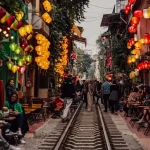
📷 Featured image by Rizki Oceano on Unsplash.