💰 Click here to see Vietnam Budget Breakdown
💰 Prices updated: November, 2026. Budget figures are estimates — always verify before travel.
Exchange Rate: $1 USD = ₫25,797.29
Daily Budget (per person)
Shoestring: ₫700,000 – ₫1,100,000 ($27.13 – $42.64)
Mid-range: ₫1,500,000 – ₫2,800,000 ($58.15 – $108.54)
Comfortable: ₫3,000,000 – ₫5,500,000 ($116.29 – $213.20)
Accommodation (per night)
Hostel/guesthouse: ₫120,000 – ₫470,000 ($4.65 – $18.22)
Mid-range hotel: ₫700,000 – ₫1,800,000 ($27.13 – $69.77)
Food (per meal)
Budget meal: ₫40,000.00 ($1.55)
Mid-range meal: ₫150,000.00 ($5.81)
Upscale meal: ₫1,000,000.00 ($38.76)
Transport
Single metro/bus trip: ₫10,000.00 ($0.39)
Monthly transport pass: ₫500,000.00 ($19.38)
Most travellers in 2026 treat Hue as a quick stop between Hanoi and Hoi An. They arrive tired, walk the Citadel at noon in 36°C heat, and leave thinking it was “just ruins.” Hue rewards a slower, better-planned visit. This guide shows you how to read the city, what to see in what order, and how to eat and move around without wasting a day.
Why Hue Feels Different
Hue was the capital of Vietnam under the Nguyen dynasty from 1802 to 1945, the last imperial family to rule the country. That history shapes everything here. The pace is slower than in Hanoi or Ho Chi Minh City. Women in purple ao dai cycle home from school along the Perfume River. Conversations are softer, and the food is more refined and more heavily spiced than elsewhere in Vietnam.
The city was also badly damaged. Much of the palace complex was destroyed during the 1968 Tet Offensive, and decades of neglect finished what the fighting started. UNESCO listed the Complex of Hue Monuments in 1993, and restoration has continued ever since. Since 1 January 2025, Hue has also been a centrally governed city, a status that has brought more investment in heritage and tourism infrastructure. What you see in 2026 is a work in progress: some halls fully restored, others still open ground with foundation stones.
Inside the Imperial City
The Citadel is a huge square fortress on the north bank of the river, built from 1805 under Emperor Gia Long. Inside it, the walled Imperial City held the ceremonial palaces. Deeper still was the Forbidden Purple City, reserved for the emperor and his household.
Enter through Ngo Mon Gate, where the emperor once appeared before crowds. Beyond it, Thai Hoa Palace is the highlight. Its red-and-gold lacquered columns still hold the throne where coronations and major court ceremonies took place. Photography is allowed in most halls, but not in every one, so look for signs.
Further back, the Forbidden Purple City is mostly open grass and foundation stones, which is hard to read without context. Restored buildings like the Can Chanh Palace and the Duyet Thi Duong royal theatre show what the original looked like. Performances of Nha Nhac, Hue’s court music, are listed by UNESCO, and the theatre sometimes hosts short shows with costumed musicians.
Allow three hours minimum. The stone paths bake by 11:00, and the smell of hot flagstones and frangipani hangs over the courtyards. Go at opening time, around 07:00, and you will have the courtyards almost to yourself.
The Royal Tombs
The tombs sit 7 to 16 km south of the centre, scattered along the river and through pine-covered hills. Emperors designed their own tombs while still alive, so each one reflects its owner’s personality. You do not need to see all of them. Three are enough.
Tu Duc: the poet’s retreat
Emperor Tu Duc (reigned 1848–1883) built a lakeside complex with pavilions, frangipani groves and a tomb he never used. It feels more like a garden than a monument, and it is the best choice if you only have time for one.
Khai Dinh: the showpiece
Built in the 1920s, Khai Dinh’s tomb mixes Vietnamese and European styles. Its interior is covered in mosaics of broken porcelain and coloured glass. It is smaller than the others but the most visually striking, and it is the most photographed.
Minh Mang: the formal masterpiece
Minh Mang’s tomb follows a strict central axis of courtyards, bridges and lotus ponds. It is the most symmetrical and calmest of the three, and the best for a slow walk.
Pagodas, Garden Houses and the Perfume River
Thien Mu Pagoda, founded in 1601, is free to enter. Its seven-storey octagonal tower overlooks the river, and monks chant here in the late afternoon. Nearby is the Austin car that carried the monk Thich Quang Duc to his self-immolation in Saigon in 1963, a powerful piece of modern history.
Hue’s garden houses (nha vuon) are the other overlooked highlight. These are family homes set within walled gardens of fruit trees, ponds and bonsai. Some, in the Kim Long and An Hien areas, open to visitors for tea and a simple meal. They give you a sense of how the nobility lived after the court declined.
The Perfume River itself is best at dusk, when Truong Tien Bridge lights up in changing colours and families gather on the riverbank. A dragon boat trip to Thien Mu is a classic, but the road is faster and cheaper.
Where to Eat in Hue
Hue’s cuisine grew out of the court kitchens, where dishes were small, precise and beautiful. Many survive today as cheap street food. In small shops, the sizzle of banh khoai batter hitting hot oil is the sound of lunch.

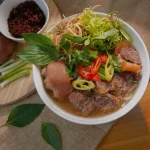
- Bun bo Hue: spicy beef noodle soup with lemongrass and chilli. Bun Bo Ba Tuyet on Nguyen Cong Tru is a long-running local favourite, usually open for breakfast only. Expect to pay 40,000–60,000 VND ($1.60–2.40).
- Banh khoai: a crisp, savoury Hue pancake with shrimp and pork, served with a thick peanut dipping sauce. Hong Mai on Dinh Tien Hoang is well known for it.
- Banh beo, banh loc and banh nam: small steamed rice cakes with shrimp and fried shallots. Hanh Restaurant on Pho Duc Chinh serves a good sampler plate for under 100,000 VND ($4).
- Com hen: rice with tiny river clams, chilli and herbs, served cold and rich in flavour.
- Che Hue: sweet dessert soups, often sold in plastic cups near Dong Ba Market for 10,000–20,000 VND (under $1).
For a royal-style set meal, book a garden house restaurant a day ahead. Expect 400,000–800,000 VND ($16–32) per person for multi-course menus.
Getting to Hue
- Train: The Reunification Express stops at Hue Station. Hanoi to Hue takes 13 to 15 hours, with sleeper berths from about 700,000 VND ($28). The Da Nang to Hue leg, about 2.5 to 3 hours, hugs the coast and passes Hai Van Pass. It is one of the most scenic rail rides in Southeast Asia, so sit on the right-hand side heading north.
- Flight: Phu Bai Airport is about 15 km south of the centre. Vietnam Airlines and Vietjet fly from Hanoi (about 1 hour 20 minutes) and Ho Chi Minh City (about 1 hour 30 minutes). A taxi or Grab to the centre costs roughly 250,000–350,000 VND ($10–14).
- Bus: Sleeper buses run from Hanoi, Da Nang and Hoi An. Da Nang to Hue takes about 2.5 to 3 hours and costs 100,000–180,000 VND ($4–7).
- Car: The expressway network from Da Nang through the Hai Van Tunnel has cut the drive to about 2 to 2.5 hours. A private car from Da Nang costs around 1,200,000–1,800,000 VND ($48–72).
Getting Around Hue
The Citadel and the main restaurant streets are walkable. Grab cars and bikes work well in Hue, and short rides cost 20,000–50,000 VND (under $2). The tombs are the challenge: they are spread out and lack shade. Options include:
- Motorbike rental: 120,000–180,000 VND ($5–7) a day. The roads to the tombs are quiet and easy.
- Private car with driver: 700,000–1,000,000 VND ($28–40) for a half-day tomb circuit.
- Cyclo: a slow, atmospheric ride around the Citadel, about 150,000–250,000 VND ($6–10) per hour. Agree on the price first.
- Dragon boat: 400,000–600,000 VND ($16–24) per boat for a trip to Thien Mu.
Day Trip or Overnight?
A day trip from Da Nang or Hoi An is possible but rushed. You lose five to six hours in transit and end up at the Citadel in the midday heat. You would see the Imperial City, perhaps one tomb and Thien Mu, with no time to eat properly.
Stay two nights. That gives you one morning for the Citadel, one afternoon for the tombs, and evenings for the river and food. If you only have one night, arrive by the early train, do the Citadel, and spend the next morning at Tu Duc or Khai Dinh before leaving. Hue works much better as a destination than as a pit stop.
Hue Budget Reality in 2026
Hue is one of the cheaper places to travel in central Vietnam. Entrance fees are the biggest fixed cost. The Imperial City costs about 200,000 VND ($8) and each tomb about 150,000 VND ($6). A combo ticket covering the Imperial City and two tombs costs roughly 420,000 VND ($17). Check the current price at the gate, as fees change.
- Budget (500,000–800,000 VND / $20–32 a day): a dorm bed at 120,000–250,000 VND, street food meals at 30,000–60,000 VND, walking and Grab for transport, one major site per day.
- Mid-range (1,200,000–2,200,000 VND / $48–88 a day): a private room or boutique hotel at 600,000–1,400,000 VND, restaurant meals, a motorbike or half-day car hire, and a combo ticket.
- Comfortable (3,000,000 VND+ / $120+ a day): a riverside or heritage hotel at 2,500,000–5,000,000 VND, a private driver and guide, and a royal-style set dinner.
Best Time and Practical Tips
The best months are February to May, with mild weather and clear skies. June to August is hot and can reach 38°C, so start early. From September to December, rain is frequent and flooding is possible in October and November. Always check forecasts, as typhoons can disrupt trains, flights and the Hai Van Pass.
- Dress modestly at pagodas and tombs: cover shoulders and knees.
- Carry water, a hat and sunscreen. Shade inside the Citadel is limited.
- Carry small bills for entrance fees, cyclos and market stalls.
- Hue Festival has traditionally been held in even-numbered years, so check dates for 2026 if you want to attend.
- Most visitors from many countries can apply for the e-visa, valid for up to 90 days. Arrange it before you arrive.

Frequently Asked Questions
How many days do you need in Hue?
Two full days is ideal. Spend one day on the Imperial City, Thien Mu Pagoda and the riverside at night, and the next on the royal tombs and a garden house lunch. One day is enough only for the highlights, and you will feel rushed.
Is Hue worth visiting in 2026?
Yes. Hue is the best place in Vietnam to understand imperial history. Restoration continues to open new halls inside the Citadel, the food is among the best in the country, and it is cheaper and calmer than Hanoi, Hoi An or Ho Chi Minh City.
How much does it cost to enter the Imperial City in Hue?
Adult entry to the Imperial City costs about 200,000 VND (roughly $8). Individual tombs cost about 150,000 VND ($6), and combo tickets covering several sites cost around 420,000 VND ($17). Prices can change, so confirm at the ticket office when you arrive.
What is the best way to see the royal tombs?
Rent a motorbike if you are confident riding, or hire a private car with a driver for a half-day circuit at around 700,000–1,000,000 VND ($28–40). Dragon boats are scenic but slow. Start early, because the tombs are exposed to the sun and get hot quickly.
Can you visit Hue as a day trip from Da Nang or Hoi An?
Yes, but it is tiring. The drive takes about 2 to 3 hours each way, leaving only four or five hours on site. You can see the Imperial City and one tomb, but you will miss the food and evenings that make Hue special.
📷 Featured image by Léo Nguyen on Unsplash.