On this page
- What “Street Food Etiquette” Really Means in Vietnam
- Reading a Street Food Stall Before You Commit
- How Ordering Actually Works
- Sitting, Eating, and the Physical Language of Respect
- Chopstick Rules Specific to Street Food
- Paying the Bill — The Logic Behind the Ritual
- 2026 Budget Reality: What Street Food Actually Costs
- How Street Food Culture Differs Across the Country
- Frequently Asked Questions
Vietnam‘s street food scene is one of the most exciting and accessible in the world — but in 2026, with tourist numbers back to pre-pandemic highs and overtourism pressuring popular food streets in Hanoi and Ho Chi Minh City, vendors are less forgiving of clueless behaviour than they once were. Pointing at dishes, sitting at the wrong stall, and fumbling over the bill in a way that holds up the queue can earn you cold service or inflated prices. None of this needs to happen. Understanding how street food actually works in Vietnam — the rhythm, the rules, and the unspoken signals — makes every meal faster, cheaper, and far more enjoyable.
What “Street Food Etiquette” Really Means in Vietnam
In most Western countries, etiquette at a food stall means saying please and thank you. In Vietnam, it means something much more layered. Street food is not just eating — it is a social ritual shaped by Confucian values around hierarchy, community, and practicality. The vendor running a bún bò Huế stall at 6am has likely been doing it for twenty or thirty years. They have a system. They know their regulars by order, not by name. Walking into that system respectfully means understanding that you are the guest, not the customer in a Western transactional sense.
Vietnamese street food culture also varies by region. Hanoi vendors are famously no-nonsense — efficiency is valued over warmth with strangers. In Hội An or Huế, there is more room for conversation. In Hồ Chí Minh City, the pace is faster and vendors expect you to keep up. Before you sit down anywhere, you are already communicating something about yourself — by where you sit, how you gesture, and whether you look like you know what you are doing.
Reading a Street Food Stall Before You Commit
Most street food stalls in Vietnam serve one dish, sometimes two. This is the first thing to understand. A woman with a cart, a gas burner, and a stack of bowls is not running a menu — she is running a single speciality, perfected over years. Walk past a few stalls before sitting. Look at what is already in front of seated diners. That is your menu.

There are also visual cues that separate a stall worth sitting at from one to skip. A stall with a queue of locals, a pot of broth that has clearly been simmering since before dawn, and plastic stools packed close together is almost always the right choice. The smell hits you before you decide — a good phở stall in the early morning carries that deep, star anise-and-charred-onion aroma that stops you mid-stride.
Check the condiment setup on the table. A proper street stall in Vietnam will have a small tray or cluster of bottles: fish sauce, chilli sauce, fresh chillies, sometimes a lime wedge or hoisin depending on the dish. This is a sign the vendor knows their dish and its accompaniments. A bare table with just chopsticks suggests a newer or less serious operation.
One practical note for 2026: many popular food streets in Hà Nội’s Old Quarter and the Bến Thành area of Hồ Chí Minh City now have look-alike stalls targeting tourists. The food is edible but overpriced. The real signal is whether the plastic stools are facing inward toward the stall, with locals in work clothes eating quickly. If every diner looks like a tourist, walk further.
How Ordering Actually Works
There is no menu handed to you. There is no server who will check back in two minutes. The ordering system at a Vietnamese street food stall is almost entirely verbal and gestural, and it moves fast.

When you sit down, the vendor — or sometimes a family member helping — will look at you. That look is the question. If you know what is being served, you respond with the number of portions: một (one), hai (two), and so on. If you are unsure, pointing at what the person next to you is eating is completely acceptable. Vendors understand this immediately and take no offence.
For dishes with customisable elements — like bún bò, where you might want more or less noodles, or phở where you choose beef cuts — regulars state their preferences in a single quick sentence. As a first-timer, simply sitting down and nodding will almost always get you the standard serving. This is perfectly fine. Do not over-explain or try to have a lengthy conversation about your dietary preferences at a busy stall during the morning rush. If you have a genuine allergy, learn the Vietnamese phrase before you go: Tôi dị ứng với… (I am allergic to…).
At many stalls, especially for dishes like bánh mì or bánh xèo, you watch the vendor make your food. The sizzle of bánh xèo batter hitting a blazing-hot pan is half the experience — a loud, violent hiss that fills the narrow alley and draws you in before you even see the finished dish. Do not rush the vendor. Street food in Vietnam is fast, but it is not fast food — there is craft in the timing.

Sitting, Eating, and the Physical Language of Respect
Street food in Vietnam is almost always eaten on low plastic stools at low plastic tables. This is not a design quirk — it is a deliberate cultural setup that creates a communal, ground-level eating experience. Sit properly on the stool (not perching on the edge as if you are about to leave) and place your bag somewhere that does not block the path. At a busy stall, space is shared and movement between tables is constant.
Slurping noodles is not rude — it is normal and expected. It helps cool the broth as you eat and signals that you are enjoying the food. Eating quietly in the Western style at a phở stall will make you look oddly uncomfortable. Let yourself slurp.
Sharing food is common in Vietnamese culture broadly, but at a street food stall serving individual bowls, each person eats their own dish. The communal eating customs you see at home-cooked meals — sharing from central dishes — do not usually apply here. If you order one bánh mì to share between two people, that is fine, but it is unusual and the vendor will simply wrap it for one.
Do not linger after you finish. Street food stools are high-turnover. Once you are done eating, pay and leave. Sitting and chatting for twenty minutes after finishing your bowl is not part of the culture and blocks a stool from someone who actually wants to eat. This is especially important during the breakfast rush between 6am and 8am, which is the peak time for most street food stalls in Vietnam.
Phones are fine — taking photos of the food before eating is now so common across Vietnam that vendors barely notice. What is less acceptable is filming the vendor’s face or their cooking process without asking. A simple nod and a gesture at your phone while smiling usually gets you permission.

Chopstick Rules Specific to Street Food
Most chopstick etiquette rules in Vietnam overlap with broader East Asian customs, but there are specific behaviours that matter most in a street food context.
- Never stick chopsticks upright in a bowl of rice or noodles. This mimics the incense offerings placed at altars for the dead and is genuinely offensive to Vietnamese people, not just mildly awkward.
- Do not pass food chopstick-to-chopstick. This is associated with funeral rites where bones are passed between family members. Place the food on someone’s plate or bowl instead.
- Use both hands to hold or receive the bowl. Cradling your bowl of phở with two hands when picking it up to drink the broth is respectful. Using one hand while the other is on your phone signals distraction.
- Resting chopsticks on the bowl rim is the normal pause position at a street stall. Chopstick rests are rare at street level — the bowl itself is the rest.
- At stalls with communal condiment dishes (a shared plate of fresh herbs or sliced chillies), use the serving chopsticks if provided, or use the clean end of your own chopsticks to take food. Do not use the eating end.
One thing that trips up many first-time visitors: Vietnamese noodle soups are meant to be eaten with both chopsticks and a spoon simultaneously. The chopsticks lift the noodles, the spoon catches the broth. Using only chopsticks for phở or bún bò is technically possible but cumbersome. Most stalls provide a ceramic spoon automatically.

Paying the Bill — The Logic Behind the Ritual
Paying for street food in Vietnam has its own unspoken rules, and getting them wrong is one of the most common ways tourists slow things down or overpay.
At most street stalls, you pay after eating, not before. The vendor tracks what you ordered mentally — they do this hundreds of times a day. When you are ready to pay, catch the vendor’s eye and either hold up cash or say tính tiền (settle the bill). Do not wave money around while still eating; it looks rushed and can cause confusion about whether you are done.
Prices at genuine local stalls are fixed and consistent. There is no negotiating at a street food stall the way you might at a market. Attempting to bargain for a bowl of phở is offensive and pointless. The vendor has a price; you pay it or you do not eat there.
Always carry small denomination notes — 5,000 VND, 10,000 VND, 20,000 VND bills. In 2026, most stalls still operate cash-only, though a growing number accept VietQR transfers (scan-and-pay QR codes linked to Vietnamese bank apps). If you have a Vietnamese bank account or an app like MOMO set up, this is increasingly useful. Foreign cards are rarely accepted at street level.
Tipping is not part of Vietnamese street food culture. Leaving 5,000 VND on the table (roughly $0.20 USD) is sometimes done but holds no real social meaning. Attempting to tip with foreign coins creates a problem for the vendor who cannot exchange them. Just pay the exact or near-exact amount and move on.
2026 Budget Reality: What Street Food Actually Costs
Vietnam’s street food prices have increased moderately since 2024, largely due to rising ingredient costs and the return of strong domestic consumption. Tourists should expect to pay slightly more than locals at stalls in tourist-heavy areas, though this gap has narrowed as digital payment transparency increases.

Budget Tier (Typical Local Stall, Non-Tourist Area)
- Bowl of phở or bún bò Huế: 30,000–45,000 VND (~$1.20–$1.80 USD)
- Bánh mì: 20,000–35,000 VND (~$0.80–$1.40 USD)
- Bánh xèo (one portion): 25,000–40,000 VND (~$1.00–$1.60 USD)
- Cà phê sữa đá (iced milk coffee): 15,000–25,000 VND (~$0.60–$1.00 USD)
Mid-Range Tier (Popular Food Streets, Semi-Tourist Areas)
- Bowl of phở: 55,000–75,000 VND (~$2.20–$3.00 USD)
- Bánh mì: 40,000–60,000 VND (~$1.60–$2.40 USD)
- Gỏi cuốn (fresh spring rolls, 2 pieces): 30,000–50,000 VND (~$1.20–$2.00 USD)
- Bún chả: 50,000–70,000 VND (~$2.00–$2.80 USD)
Comfortable Tier (Upgraded Street-Style Restaurants with A/C)
- Most dishes: 80,000–150,000 VND (~$3.20–$6.00 USD)
- These are not street food stalls but serve the same dishes in a sit-down environment
A full street food breakfast — one noodle dish, one iced coffee — should come to no more than 60,000–80,000 VND (~$2.40–$3.20 USD) at a genuine local stall. If you are paying significantly more than this, you are either at a tourist-facing operation or in a high-rent urban district where prices are legitimately higher.
How Street Food Culture Differs Across the Country
Vietnam stretches over 1,600 kilometres from north to south, and the street food culture at each end of the country is genuinely different — not just in dishes, but in how you interact with vendors and other diners.
Northern Vietnam (Hà Nội and surrounds)
Hanoi’s street food culture is restrained and serious. Vendors are efficient, sometimes brusque, and take enormous pride in a single dish done one way. The phở of Hà Nội is lighter and more delicate than southern versions. Regulars order without looking at the vendor. Conversation during the meal is low. Foreigners are noticed but largely ignored if they sit quietly and eat properly. Attempting loud enthusiasm or excessive compliments to the chef is out of place here.

Central Vietnam (Huế, Đà Nẵng, Hội An)
Central Vietnamese food is the spiciest and most complex in the country. Stall vendors in Huế, in particular, have a strong sense of regional pride — the cuisine here was the food of the royal court, and that history is felt in even a humble bowl of bún bò Huế. Vendors are generally warmer with foreign diners than their Hanoian counterparts. In Hội An, the tourist volume means vendors have adapted to multilingual interactions, but the food itself remains fiercely traditional.
Southern Vietnam (Hồ Chí Minh City and the Mekong Delta)
Southern street food is sweeter, more herb-forward, and more informal. Hồ Chí Minh City stalls move at a pace that can feel overwhelming — you sit down and food appears almost immediately. The culture here is louder and more expressive. Vendors in the south are generally more accustomed to foreign diners and more willing to explain dishes. The Mekong Delta adds its own layer: floating markets and river-side stalls where you eat on low wooden platforms over water, and the food — bánh tráng nướng, hủ tiếu, fresh coconut-based dishes — reflects the tropical abundance around you.
Frequently Asked Questions
Is it safe to eat street food in Vietnam in 2026?
Yes, for most healthy adults. The key markers of a safe stall are high turnover (food does not sit around), cooked-to-order dishes served hot, and a crowd of local diners. Avoid pre-cut fruit left uncovered in direct sun, raw shellfish from unknown sources, and ice at very basic stalls far from urban centres. Your digestive system may need two or three days to adjust.
Do I need to speak Vietnamese to order street food?

No, but knowing a few key words helps significantly. Learning numbers one to five in Vietnamese (một, hai, ba, bốn, năm), the phrase for “how much” (bao nhiêu tiền?), and “delicious” (ngon lắm) will take you a long way. Pointing and holding up fingers covers most situations.
What should I do if I am overcharged at a street food stall?
Stay calm and ask clearly: Bao nhiêu tiền? (How much?). Genuine overcharging of tourists is less common at local stalls than people expect, but it happens. Do not argue aggressively — simply count out what you think is correct, show it calmly, and wait. Most misunderstandings are resolved quickly. Walking away without paying is never appropriate regardless of the dispute.
Are vegetarian and vegan options available at street food stalls?
Yes, though you need to know where to look. Vietnam has a strong Buddhist vegetarian tradition, and dedicated cơm chay (vegetarian rice) stalls operate across the country. These are often marked with the word chay on a sign. General street food stalls typically use fish sauce, pork broth, or lard in bases and sauces, so dishes that look vegetarian often are not. Always ask: Có thịt không? (Does it have meat?)
Is it rude to refuse food or leave a dish unfinished at a street food stall?
At a street stall, no. The social pressure to finish every bite that applies at a Vietnamese family dinner does not carry over to a commercial street food context. Leaving some broth or a few noodles is completely normal. What matters is that you pay for what you ordered. Refusing to eat something after it has been served and prepared is mildly awkward but not a serious offence — simply pay and leave politely.
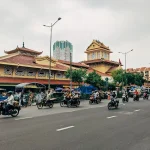
📷 Featured image by Matthew Stephenson on Unsplash.