On this page
- What Tet Actually Is (and Why It’s Not Just Vietnamese New Year)
- The Week Before Tet: Rituals That Start Long Before Midnight
- The Kitchen God Ceremony: Vietnam’s Most Overlooked Tradition
- Tet Food as Religious Act, Not Just Celebration
- How Families Structure the Three Days of Tet
- What Foreigners Get Wrong About Tet (and How to Do It Right)
- 2026 Tet Dates, Closures, and Budget Reality
- Frequently Asked Questions
What Tet Actually Is (and Why It’s Not Just Vietnamese New Year)
Most travel content reduces Tet to fireworks, red envelopes, and crowded airports. That framing misses almost everything. In 2026, with international arrivals to Vietnam hitting record numbers around the Lunar New Year period, more foreigners than ever will be present during Tet — staying in Vietnamese homes as guests, navigating cities that shut down almost completely, or simply trying to understand what they are witnessing on the street. A surface-level understanding of Tet creates awkward moments. A deeper one opens doors.
Tet Nguyen Dan — the full name — translates roughly as “Festival of the First Morning of the First Day.” It marks the start of the lunar Calendar year, but it is simultaneously a harvest festival, an ancestor veneration ceremony, a family reunion ritual, and a spiritual reset for the entire household. The Western framing of “New Year” captures maybe 20 percent of what is actually happening. The other 80 percent involves the spirit world, the family dead, the kitchen god, debts both financial and moral, and a set of deeply held beliefs about how the first moments of a new year shape everything that follows.
Vietnamese people will often laugh and say “Tet is just like Christmas for us” to make it digestible for foreigners. That comparison is kind but incomplete. Tet carries the weight of Christmas, New Year’s Eve, Easter, and a major ancestral memorial day compressed into roughly a week — with religious significance that many Vietnamese, even secular ones, take seriously on a gut level.
The Week Before Tet: Rituals That Start Long Before Midnight
The countdown to Tet doesn’t begin at midnight. It begins roughly a week before, and the preparations are their own ritual sequence with specific meaning attached to each action.
Cleaning the house is mandatory — and not just tidying. Vietnamese families do a deep clean of the entire home in the days before Tet to sweep out the bad luck of the previous year. Crucially, once Tet begins, you do not sweep for at least the first day, sometimes longer, because you risk sweeping the new year’s good fortune out the door. Foreigners staying with Vietnamese families should know this — grabbing a broom on Tet morning to “help” is well-intentioned but genuinely alarming to the host.
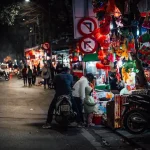
The markets in the week before Tet are something else entirely. The smell of chrysanthemums, kumquat trees, and fresh-cut branches of hoa mai (yellow apricot blossom, common in the South) or hoa dao (peach blossom, common in the North) fills every street. These blossoming branches are not decorative in a casual sense — they represent renewal and prosperity, and the right branch at the right price is a subject of genuine negotiation and pride. The last night before Tet, temporary flower markets stay open until the early hours, and the atmosphere is frantic and electric, lit by fluorescent bulbs and motorbike headlights, the air thick with the scent of wet soil from potted plants stacked three-deep on the pavement.

Debts are also supposed to be settled before Tet. Entering the new year owing money is considered bad luck, and many Vietnamese will go to significant lengths to clear financial obligations before the holiday begins. Foreigners who owe money to Vietnamese friends or colleagues — for split dinners, shared transport, anything — should make the effort to pay up before Tet arrives.
The Kitchen God Ceremony: Vietnam’s Most Overlooked Tradition
On the 23rd day of the 12th lunar month — typically falling in late January — Vietnamese families perform one of the most quietly significant ceremonies of the entire Tet season: the farewell of Ong Tao, the Kitchen God.
According to Vietnamese folk belief, Ong Tao (sometimes described as three gods sharing the role) lives in the family kitchen and reports to the Jade Emperor in heaven on the behavior and affairs of the household each year. On the 23rd, he makes his annual journey upward. Families send him off properly: offerings of fruit, sticky rice, and paper goods are laid out, incense is burned, and — most famously — live carp are released into a river, lake, or pond, because the carp is believed to carry Ong Tao to heaven.
In Hanoi, this tradition turns Hoan Kiem Lake and the West Lake shoreline into a scene of respectful chaos for a morning, as thousands of families arrive with plastic bags of carp to release. By 2026, city authorities have continued their ongoing campaign to discourage people from also releasing the plastic bags into the water, with mixed success. The ceremony itself is brief, sincere, and largely invisible to tourists who don’t know to look for it. Ong Tao returns to the household on New Year’s Eve, which is why the kitchen altar must be clean and prepared by then.
Tet Food as Religious Act, Not Just Celebration

Tet food is not party food. Every dish on the Tet table carries specific meaning, and the preparation of those dishes is itself an act of devotion — to the family, to the ancestors, and to the new year.
Banh chung (in the North) and banh tet (in the South) are the cornerstone dishes: sticky rice cakes filled with mung bean paste and pork fat, wrapped tightly in dong leaves and boiled for many hours. The square shape of banh chung represents the earth in Vietnamese cosmology. Making banh chung is a family event — grandparents, parents, and children sit together to wrap and tie the cakes, often through the night, watching the pot. The recipe traces back more than 2,000 years. Buying banh chung from a shop is practical. Making it at home is a statement about who you are as a family.
The ancestral altar receives food offerings before the living family eats. Plates of fruit, tea, banh chung, and other dishes are placed at the altar and left for the ancestors who are believed to return home during Tet. The family eats only after this offering has been made. A foreigner invited to a Tet meal who begins eating before the host has completed the offering to the ancestors will cause quiet discomfort — watch and wait for the signal that it is time.
Mut — candied fruits and vegetables — fills lacquered boxes on every coffee table during Tet visits. Offering mut to a guest is a gesture of welcome. Eating a piece or two when offered, even if you find the sweetness overwhelming, is polite. Declining entirely is a small but noticeable slight.
How Families Structure the Three Days of Tet
The first three days of Tet follow a loose but widely understood structure across Vietnamese families, though regional and family customs vary.
Mung 1 (Day One) is for the paternal family. The husband’s side of the family gathers — grandparents, aunts, uncles, cousins. This is the most formal and most spiritually significant day. The first person to step through the front door of the house on Mung 1 is called the xong dat (or xong nha), and this person’s character, age, and fortune are believed to set the tone for the entire household’s luck in the coming year. Vietnamese families often quietly pre-select who they want this first visitor to be — usually someone considered fortunate, successful, and positive. Foreigners should never show up unannounced at a Vietnamese home on Mung 1 morning for this reason. If you’ve been specifically invited and told to come early, that is a significant sign of trust and affection.

Mung 2 (Day Two) belongs to the maternal family — the wife’s parents and relatives. Families spend this day visiting the mother’s side, which often means traveling across town or to another province entirely.
Mung 3 (Day Three) is traditionally reserved for visiting teachers and mentors — a reflection of the deep Confucian respect for education embedded in Vietnamese culture. In practice, by 2026 this day is more flexible, used for friends, neighbors, and social visits.
Li xi — the red envelopes containing lucky money — are given to children and unmarried young adults throughout all three days. Elders give to the young. If you are a foreigner visiting a Vietnamese family with children, having a few small red envelopes prepared with 50,000 VND (about USD 2) inside each one will earn you extraordinary goodwill. The amount is less important than the gesture of participating in the tradition.
What Foreigners Get Wrong About Tet (and How to Do It Right)
The most common mistake foreigners make during Tet is treating it like a spectator event — something to watch from a distance and photograph. Tet is a participatory culture. Vietnamese people are generally delighted when foreigners make sincere, informed efforts to join in, and they are equally — though quietly — put off by foreigners who treat the holiday as a backdrop for content creation while ignoring the living meaning around them.
A few specific things to know:
- Don’t wear white or black to Tet celebrations. Both colors are associated with funerals and mourning. Opt for red, yellow, orange, or green — any warm or bright color signals celebration and good fortune.
- Don’t talk about death, illness, or bad luck during Tet. The belief that what you say and do in the new year echoes through the rest of it is taken seriously. Keep conversation positive.
- Don’t break things. Dropping and breaking a bowl or glass during Tet is considered genuinely bad luck, not just clumsy. Be careful in kitchens and at the table.
- Don’t ask someone how much their li xi contained. It’s private. Children sometimes compare among themselves, but asking an adult how much money was in their envelope is rude.
- Don’t expect businesses to be open. In smaller cities and towns, the shutdown is near-total for at least three days. Even in Ho Chi Minh City and Hanoi, the streets on Mung 1 and Mung 2 are hauntingly quiet — a version of these cities you will not see at any other time of year. Plan food and supplies accordingly.

The things that will make you a genuinely welcome presence: learning a few Tet phrases in Vietnamese (especially Chuc Mung Nam Moi — Happy New Year), eating what you’re offered, showing patience, and asking questions with genuine curiosity rather than polite performance.
2026 Tet Dates, Closures, and Budget Reality
Tet 2026 falls on February 17, 2026 — the Year of the Horse begins. The official public holiday runs from February 14 to February 20 (seven days), though many businesses close from as early as February 12 and do not fully reopen until February 22 or later.
Flight prices during the Tet travel window (roughly February 10–25) are extreme. Domestic routes between Hanoi, Da Nang, and Ho Chi Minh City can spike to three to five times their normal price. International routes see similar pressure. By 2026, Vietnam Airlines, VietJet, and Bamboo Airways have all expanded capacity on peak Tet routes, but the demand still far outpaces supply. Book domestic flights no later than November 2025 if you plan to be anywhere near Vietnam during this period.
The new Hanoi Metro Line 3 extension (operational since late 2025) connects the city center to Noi Bai Airport, which significantly reduces the transport chaos that previously made Tet arrivals and departures particularly grueling. In Ho Chi Minh City, the Ben Thanh–Suoi Tien Metro Line 1 continues to ease surface congestion during holiday travel peaks.
2026 Tet Budget Reality
- Budget traveler: Accommodation 300,000–600,000 VND per night (USD 12–24). Expect limited food options during the holiday itself — stock up on instant noodles and convenience store supplies, which stay open. Street food largely disappears for 2–3 days.
- Mid-range traveler: Hotel rooms 1,000,000–2,500,000 VND per night (USD 40–100). Most three-star and above hotels in major cities maintain restaurant service during Tet, though menus are reduced. Expect to pay a 20–30 percent premium on standard rates.
- Comfortable traveler: 3,000,000 VND and above per night (USD 120+). Five-star hotels in Hanoi and Ho Chi Minh City run special Tet packages including curated dinners, banh chung-making workshops, and lion dance performances. These packages typically cost 2,000,000–4,000,000 VND (USD 80–160) per person and sell out by December.

ATMs run dry fast during Tet. Vietnamese families withdraw large amounts of cash before the holiday for li xi and expenses. Withdraw a substantial amount of cash before February 12 if you plan to be in Vietnam, particularly if you are visiting smaller cities or rural areas where card payment is less common.
Frequently Asked Questions
When exactly does Tet 2026 start and how long does it last?
Tet 2026 begins on February 17, 2026, the first day of the Year of the Horse. The official public holiday runs seven days, from February 14 to February 20. In practice, many Vietnamese businesses and families observe a longer break, with full normal operations often not resuming until February 22 or 23.
Is it a good or bad idea to travel in Vietnam during Tet?
It depends entirely on what you want. Tet in a Vietnamese home or village is one of the most extraordinary cultural experiences in Southeast Asia. Tet as an independent traveler trying to move between cities, find open restaurants, and access services is genuinely difficult. The country essentially pauses for several days. Plan with that reality firmly in mind.
Can foreigners participate in Tet celebrations, or is it a private family affair?
Vietnamese people are generally warm toward foreigners who show genuine interest and respect for Tet traditions. Being invited to a Vietnamese family’s home for Tet is a real honor. If you are invited, accept. Bring a fruit basket, wear bright colors, and learn at least one Tet greeting in Vietnamese. You will be welcomed far more than you expect.
What is li xi and is it appropriate for a foreigner to give red envelopes?
Li xi are small red envelopes containing lucky money, given from elders to children and young unmarried adults during Tet. Foreigners absolutely can and should participate if they are visiting Vietnamese families with children. Put 20,000–50,000 VND (USD 1–2) in each envelope. The amount is symbolic — the gesture of participation is what matters most.
Why are Vietnamese cities so empty during Tet, and where does everyone go?
Vietnam’s urban population is largely made up of people who originally come from smaller towns, rural areas, and other provinces. Tet triggers the world’s largest internal migration as millions of workers return to their home provinces and villages to be with family. Cities like Ho Chi Minh City can lose a significant portion of their population for a week, resulting in eerily quiet streets that are genuinely unlike anything you’ll see the rest of the year.
📷 Featured image by Hieu Do Quang on Unsplash.