On this page
- The Imperial Enclosure: Navigating the Walled City in 2026
- The Forbidden Purple City: What Survived, What Didn’t, and Why It Matters
- The Royal Tombs Outside the Walls: Which Ones Are Worth the Trip
- Hue’s Royal Cuisine: Where the Palace Kitchen Lives On
- Getting to Hue and Getting Around the Imperial Sites
- Day Trip or Overnight? Making the Right Call
- 2026 Budget Reality: Tickets, Food, and Transport Costs
- Practical Tips: Hours, Crowds, and What Catches Visitors Off Guard
- Frequently Asked Questions
💰 Click here to see Vietnam Budget Breakdown
💰 Prices updated: October, 2026. Budget figures are estimates — always verify before travel.
Exchange Rate: $1 USD = ₫25,964.41
Daily Budget (per person)
Shoestring: ₫650,000 – ₫1,550,000 ($25.03 – $59.70)
Mid-range: ₫1,800,000 – ₫3,900,000 ($69.33 – $150.21)
Comfortable: ₫5,200,000 – ₫9,100,000 ($200.27 – $350.48)
Accommodation (per night)
Hostel/guesthouse: ₫120,000 – ₫350,000 ($4.62 – $13.48)
Mid-range hotel: ₫780,000 – ₫1,850,000 ($30.04 – $71.25)
Food (per meal)
Budget meal: ₫60,000.00 ($2.31)
Mid-range meal: ₫250,000.00 ($9.63)
Upscale meal: ₫800,000.00 ($30.81)
Transport
Single metro/bus trip: ₫10,000.00 ($0.39)
Monthly transport pass: ₫300,000.00 ($11.55)
Hue sits at a strange crossroads in 2026 — it’s one of the most historically significant cities in Southeast Asia, yet it still gets treated as a quick stop between Da Nang and Hoi An. Travelers racing through on a two-night itinerary miss most of what makes this place genuinely different from anywhere else in Vietnam. The Imperial City alone can swallow a full day if you approach it properly, and the royal tombs scattered along the Perfume River deserve their own half-day entirely. This guide is for people who want to understand what they’re looking at, not just photograph it.
The Imperial Enclosure: Navigating the Walled City in 2026
The Imperial Enclosure — locally called Hoàng Thành — sits inside the larger Citadel, a massive fortified square surrounded by a moat and thick stone walls. Walking through the Ngọ Môn Gate, the main southern entrance, the scale hits you immediately. The courtyard opens up wide, the heat radiates off the stone paving, and you can hear the creak of wooden roof beams in the older pavilions shifting with the afternoon wind. It feels less like a museum and more like a city that simply ran out of time.
The UNESCO-listed complex covers around 37 hectares inside the walls. Most visitors enter at Ngọ Môn and move north toward the Thai Hoa Palace (Palace of Supreme Harmony), which is the ceremonial heart of the complex and still one of the best-preserved structures on the site. The red lacquered columns, the gilded throne, and the layered roof tiles in imperial yellow give you a clear sense of what Nguyen Dynasty power looked like in its prime.
From Thai Hoa, the route continues through two more enclosed areas: the Great Interior Gate and then the Forbidden Purple City beyond. Give yourself a minimum of three hours for the enclosure alone. The northern and western wings are less visited and more atmospheric — you’ll find collapsed rooflines, overgrown courtyards, and a few pavilions mid-restoration. In 2026, active restoration work is ongoing in the northeast section with funding from both the Vietnamese government and UNESCO partners, so some areas may be partially fenced off.
The Forbidden Purple City: What Survived, What Didn’t, and Why It Matters
The Tử Cấm Thành (Forbidden Purple City) is the innermost sanctum of the entire Hue complex — the private residence of the emperor and his family, off-limits to nearly everyone during the Nguyen Dynasty’s 143-year reign. What you find today is a place defined more by its absences than what’s standing.
The Forbidden Purple City was devastated twice: first during the 1947 French bombardment, and then severely again during the 1968 Tet Offensive, when Hue became the site of one of the war’s longest and bloodiest urban battles. Of the original 50-plus buildings, a handful remain structurally intact. The Royal Theater (Duyet Thi Duong), built in 1826, is one of the survivors and still hosts traditional royal court music performances — nhã nhạc — listed by UNESCO as Intangible Cultural Heritage.
Attending a nhã nhạc performance inside the Royal Theater is one of those experiences that rewards patience. The music is slow, layered, and unlike anything in the Vietnamese popular tradition — instruments like the đàn bầu (monochord) and the sáo trúc (bamboo flute) combine with percussion in a sound that feels ancient in the most literal sense. Performances run daily at 10:00am and 3:00pm and are included in the main complex ticket.
The spaces where the main palace buildings once stood are now open courtyards. Rather than seeing this as a loss, it helps to think of the Forbidden Purple City as a kind of honest historical document — the damage itself tells the story of what Vietnam went through in the 20th century. Interpretive boards installed in 2025 now give clear explanations of what stood where, which helps enormously with context.
The Royal Tombs Outside the Walls: Which Ones Are Worth the Trip
Seven Nguyen emperors are buried in elaborate tomb complexes scattered along the Perfume River south of the city. They vary wildly in style, size, and atmosphere. You do not need to visit all seven — in fact, trying to do so in one day turns them into a blur. Here’s how to think about the three that matter most:
- Tomb of Tự Đức (1864–1867): The most picturesque and the one worth prioritizing. Built while the emperor was still alive, it’s as much a retreat as a tomb — a lake, a pavilion, pavilion gardens, and a poetic stele pavilion where Tự Đức wrote his own epitaph (4,000 characters long). The setting feels genuinely peaceful, especially in the early morning when mist sits on the water.
- Tomb of Khải Định (1920–1931): Visually the most striking and the most unusual. The architecture blends Vietnamese imperial style with French Baroque and even touches of Gothic and Hindu design. The interior mosaic work — thousands of ceramic and glass fragments covering every surface — is extraordinary. It looks nothing like any other structure in Vietnam.
- Tomb of Minh Mạng (1840–1843): The most symmetrical and formally grand, set inside a large forested park. It’s the most “Chinese imperial” in feeling and gives you the clearest sense of Nguyen Dynasty cosmological thinking — the arrangement of lakes, bridges, and gateways mirrors the afterlife journey.
Budget about 90 minutes per tomb if you want to take it seriously. The tombs each have a separate admission fee from the main complex.
Hue’s Royal Cuisine: Where the Palace Kitchen Lives On
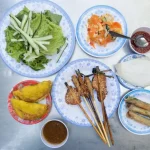
Hue has the most distinctive regional food culture in Vietnam, and it comes directly from the imperial court tradition. The Nguyen emperors reportedly demanded 50 different dishes per meal, prepared by specialist cooks for different courses. What filtered out of the palace over centuries became the street food and restaurant culture the city is known for today.
The dishes to seek out specifically in Hue:
- Bún bò Huế: A spicy, lemongrass-heavy beef noodle soup that is more complex than its cousin phở. The broth has a deep red color from fermented shrimp paste and chili, and it typically comes with slices of pork, beef, and a pork knuckle. Eat it at Bún Bò Huế Mụ Rớt on Lý Thường Kiệt — this is the kind of place with plastic stools and no English menu, and the soup arrives in a bowl so fragrant it cuts through the morning heat.
- Bánh khoái: Hue’s version of a crispy rice pancake, smaller and crunchier than the southern bánh xèo, filled with shrimp, pork, and bean sprouts. Served with a thick peanut and liver dipping sauce. Try it at the stalls around Đông Ba Market.
- Cơm hến: Cold rice mixed with tiny freshwater clams, herbs, peanuts, sesame, crispy pork skin, and fermented shrimp paste. It’s a breakfast dish, strongly flavored, and genuinely polarizing — visitors either love the funky depth of it or find it overwhelming. Either way, it’s completely unique to Hue.
- Bánh Huế set: Several restaurants near the royal tombs serve a tasting set of small Hue cakes — bánh bèo (steamed rice discs with dried shrimp), bánh nậm (flat rice dumplings in banana leaf), and bánh lọc (clear tapioca dumplings). Bánh Bèo Bà Đỏ on Nguyễn Bỉnh Khiêm is the most reliable address.
Getting to Hue and Getting Around the Imperial Sites
Hue is well-connected in 2026. The fastest option from Hanoi or Ho Chi Minh City is by air — Phu Bai International Airport is 15 kilometres south of the city center, with Vietnam Airlines, VietJet, and Bamboo Airways all running multiple daily flights. The airport has seen capacity upgrades in 2025, reducing delays that plagued the route in previous years.
By train, the Reunification Express remains an excellent option, particularly the Da Nang–Hue leg, which passes through the Hai Van Pass and delivers one of the most scenic train rides in Southeast Asia. The route takes around 2.5 to 3 hours from Da Nang and costs roughly 150,000–250,000 VND (USD 6–10) in a standard seat. The 2025 timetable improvements mean more SE trains stop at Hue at useful hours.
From Da Nang, a hired car is also common — the journey takes about 1.5 to 2 hours via the Hai Van Tunnel for those who want speed, or over the mountain pass for scenery.
Once in Hue, the Imperial City is walkable from most hotels in the central district (cross the Trương Tiền Bridge heading west). For the royal tombs, options include:
- Renting a motorbike (around 120,000–150,000 VND/day)
- Hiring a xe ôm (motorbike taxi) driver for a half-day tomb circuit — negotiate around 200,000–300,000 VND total
- Dragon boat tours on the Perfume River, which stop at select tombs and pagodas — more atmospheric but slower
Day Trip or Overnight? Making the Right Call
Hue is 100 kilometres from Da Nang and 30 kilometres from the nearest beach towns, so many travelers on tighter schedules consider it a long day trip from Da Nang or Hoi An. That works only if your interest is limited to a single pass through the Imperial Enclosure.
For anyone who wants to see even two of the royal tombs plus the main complex, plus eat properly, an overnight stay is the realistic minimum. Two nights is comfortable and lets you cover Hue without rushing. The city is calmer, cheaper, and more atmospheric after dark than either Da Nang or Hoi An — the Perfume River at night, lit by lanterns and quiet enough to hear the water, is one of the genuinely peaceful urban experiences left in Central Vietnam.
If you’re coming specifically for the tombs and the full imperial story, three nights allows you to add Thien Mu Pagoda, the Hue Museum of Royal Fine Arts, and the less-visited sections of the Citadel at a pace where things actually register.
2026 Budget Reality: Tickets, Food, and Transport Costs
Hue’s admission pricing was restructured in 2025 into a tiered system:
- Imperial Enclosure only: 200,000 VND (~USD 8)
- Combined ticket (Imperial Enclosure + 3 royal tombs): 530,000 VND (~USD 21)
- Full Hue Monuments Complex pass (all major sites): 680,000 VND (~USD 27)
The combined or full pass is almost always worth it if you’re spending more than half a day on the sites. Individual tomb tickets are 150,000 VND each.
Daily food and transport costs by tier:
- Budget traveler: 250,000–400,000 VND/day (~USD 10–16) — street food only, motorbike rental, guesthouse
- Mid-range: 600,000–1,000,000 VND/day (~USD 24–40) — mix of local restaurants and sit-down spots, hired transport for tomb circuit, simple hotel
- Comfortable: 1,500,000 VND+ (~USD 60+) — royal cuisine restaurants, private car for tomb circuit, three-star hotel along the Perfume River
Hue is noticeably cheaper than Da Nang or Hoi An across every spending tier. A bowl of bún bò Huế at a street stall costs 40,000–55,000 VND (under USD 2.50). Even the better sit-down restaurants serving royal cuisine tasting menus rarely exceed 350,000–500,000 VND per person.
Practical Tips: Hours, Crowds, and What Catches Visitors Off Guard
The Imperial Enclosure opens at 7:00am and closes at 5:30pm daily. The royal tombs keep similar hours. Arrive early or late in the afternoon — the 11:00am–2:00pm window is both the hottest and most crowded.
Hue’s weather is genuinely complicated. The city sits in a rain shadow that works in reverse from the rest of Vietnam — its wet season runs from September to January, when Central Vietnam’s coast gets hammered by typhoons and the mountains funnel rain directly into the Hue basin. February through August is the driest and most reliable window. January visits can mean overcast, grey, and wet conditions that affect both mood and photography inside the open courtyards.
A few things that catch people off guard:
- The Imperial Enclosure is large enough that sensible footwear is essential — cobblestones, uneven stone paths, and occasional puddles in the less-maintained sections
- There is limited shade inside the complex — a hat and water are not optional in summer
- The nhã nhạc performances fill up; arrive 15 minutes before the listed start time
- Photography inside the Royal Theater is restricted during performances
- Cafes and food stalls inside the complex are limited — eat before you enter or bring snacks
Frequently Asked Questions
How long does it take to visit Hue’s Imperial City?
The Imperial Enclosure alone takes a minimum of 2.5 to 3 hours if you’re moving purposefully. Add the Forbidden Purple City, the Royal Theater performance, and some time to sit and absorb the space, and a full morning is gone. Plan a full day if you want to avoid feeling rushed inside the complex.
Is the combined ticket for Hue monuments worth buying?
Yes, if you’re visiting at least two royal tombs in addition to the Imperial Enclosure. The combined pass at 530,000 VND saves a meaningful amount compared to buying individually. The full pass makes sense if you’re spending two days covering all the major sites across the UNESCO complex.
What is the best time of year to visit Hue?
February through August offers the driest and most comfortable conditions. March to May is the sweet spot — warm but not oppressive, and the landscape around the royal tombs is lush and green. Avoid October through December if you can, as this is Hue’s rain-heavy season and open courtyards become difficult to navigate in persistent downpours.
Can I visit Hue as a day trip from Da Nang or Hoi An?
Technically yes — Da Nang is about 1.5 hours away by car and Hoi An is around 2 hours. But a day trip limits you to the Imperial Enclosure and almost nothing else. For anyone serious about the royal tombs, the food scene, or any secondary sites, at least one overnight stay is the more honest recommendation.
What has changed at Hue’s Imperial City since 2024?
Several updates in 2025–2026: the ticketing system was restructured into clearer pass tiers, new interpretive signage was installed throughout the Forbidden Purple City in English and Vietnamese, active restoration work expanded in the northeast wing, and Phu Bai Airport completed capacity improvements that reduced flight delays on the Da Nang and Hanoi routes.
📷 Featured image by Siddhesh Mangela on Unsplash.