💰 Click here to see Vietnam Budget Breakdown
💰 Prices updated: October, 2026. Budget figures are estimates — always verify before travel.
Exchange Rate: $1 USD = ₫25,964.41
Daily Budget (per person)
Shoestring: ₫650,000 – ₫1,550,000 ($25.03 – $59.70)
Mid-range: ₫1,800,000 – ₫3,900,000 ($69.33 – $150.21)
Comfortable: ₫5,200,000 – ₫9,100,000 ($200.27 – $350.48)
Accommodation (per night)
Hostel/guesthouse: ₫120,000 – ₫350,000 ($4.62 – $13.48)
Mid-range hotel: ₫780,000 – ₫1,850,000 ($30.04 – $71.25)
Food (per meal)
Budget meal: ₫60,000.00 ($2.31)
Mid-range meal: ₫250,000.00 ($9.63)
Upscale meal: ₫800,000.00 ($30.81)
Transport
Single metro/bus trip: ₫10,000.00 ($0.39)
Monthly transport pass: ₫300,000.00 ($11.55)
Where the Locals Actually Eat
One of the biggest frustrations for first-time visitors to Ho Chi Minh City in 2026 is spending three days eating in air-conditioned restaurants near Bến Thành Market and leaving convinced the food was “fine.” It wasn’t. The real eating in this city happens at plastic-stool joints with no English menu, at alley stalls that disappear by 10am, and at family-run shops that have been on the same corner for forty years. This guide skips the tourist shortcuts and points you directly at the food.
The single most reliable rule in Saigon: follow the density of parked motorbikes. If there are twenty bikes outside a stall and the owner looks too busy to acknowledge you, sit down. The food will be good.
For bún bò Huế, the fiery beef and lemongrass noodle soup that many locals rank above phở, head to the cluster of stalls on Hoàng Dư Khương Street in District 10. The broth arrives deep orange-red, smelling of shrimp paste and chilli, with thick round noodles and a bone-in pork knuckle balanced on top. It is loud, it is messy, and it is exactly right.
Cơm tấm (broken rice) is Saigon’s defining everyday dish. The best casual version in the city is arguably on Đặng Văn Bi Street in Thủ Đức — a strip of cơm tấm stalls that locals from across the city make detours for. Grilled pork chop, shredded pork skin, a steamed egg pork cake, fish sauce dressing. A full plate costs around 45,000–55,000 VND (roughly USD 1.70–2.10).
For bánh xèo (sizzling crepes), the address is Đinh Công Tráng Street in District 1. This short street is lined with nothing but bánh xèo restaurants. The batter — rice flour, turmeric, coconut milk — hits the pan with a sound that carries into the street. You wrap wedges in mustard leaf and rice paper, dip in sweet fish sauce. Go for lunch; most stalls close by early evening.
District-by-District Eating Map
Ho Chi Minh City’s eating landscape is genuinely geographic. Different districts have different food identities, and knowing which area to head to for which craving saves serious time.
District 1 — Tourist Infrastructure with Genuine Pockets
Most of District 1 is overpriced and aimed at visitors. The exceptions: the street food corridor around Bùi Viện Walking Street before 6pm (after that it becomes a nightlife strip), the phở stalls on Nguyễn Trãi Street near the Phạm Ngũ Lão backpacker zone, and the café-heavy lanes off Lý Tự Trọng Street for affordable lunch rice plates.
District 3 — The Middle-Class Saigon Sweet Spot
District 3 is where educated, food-conscious Saigonese eat without splurging. The streets around Võ Văn Tần and Nam Kỳ Khởi Nghĩa are thick with good mid-range Vietnamese restaurants. This district also has some of the city’s best bánh mì shops and serious coffee culture.
District 4 — The Seafood and Snack District
Cross the canal from District 1 and the prices drop by 30 percent. District 4 is famous for late-night seafood, grilled skewers, and bánh tráng trộn (a tangy rice paper salad that teenagers eat obsessively). The area around Xóm Chiếu Market is particularly good for fresh seafood cooked simply — steamed clams, grilled prawns, stir-fried morning glory.
District 5 (Chợ Lớn) — Vietnamese-Chinese Cooking

Chợ Lớn is one of the largest Chinatowns in Southeast Asia and the eating here reflects a centuries-old blend of Cantonese, Teochew, and Vietnamese cooking. Triệu Quang Phục Street has congee and dim sum from early morning. Hải Thượng Lãn Ông Street mixes herbal medicine shops with noodle stalls. If you want hủ tiếu Nam Vang (Phnom Penh-style pork and prawn noodle soup), this is the district.
Bình Thạnh and District 7 — New Saigon’s Eating Scenes
Bình Thạnh has matured rapidly. The area around Phan Đăng Lưu Street now has a dense cluster of good-value restaurants serving central Vietnamese food — mì Quảng, bánh canh, bún thịt nướng. District 7’s Phú Mỹ Hưng zone caters more to Korean and Japanese expat communities, with some of the city’s best Korean BBQ and Japanese ramen outside of District 1.
The Best Markets for Eating In-Situ
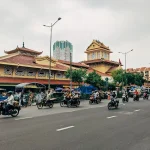
Bến Thành Market gets all the attention and deserves very little of it — prices inside are 2–3 times higher than surrounding streets and the food stalls are geared entirely toward tourists. These are the markets where Saigonese people actually eat.
- Bình Tây Market (District 5): The wholesale market of Chợ Lớn. The food stalls on the ground floor and surrounding alleys serve workers from early morning. Congee, banh bao (steamed buns), and roast duck rice at prices that feel like a decade ago.
- Tân Định Market (District 3): Surrounded by some of the best street food density in the city. Arrive between 6am and 9am for fresh bánh mì vendors, fruit sellers, and a particularly good bánh cuốn (steamed rice roll) stall just outside the main entrance on Hai Bà Trưng Street.
- Phạm Văn Hai Market (Tân Bình District): A wet market by day and a street food zone by evening. The eating here is entirely local — bún riêu, bún mắm, gỏi cuốn (fresh spring rolls) made in front of you.
- Hồ Thị Kỷ Flower Market (District 10): The surrounding streets come alive at night with flower traders and food vendors. One of the best places in the city for late-evening hủ tiếu and dessert soups (chè).

Sit-Down Restaurants Worth the Price
There are times when a plastic stool in the sun is not what you want. These restaurants deliver genuine quality without asking you to pay District 1 tourist prices for the atmosphere alone.
For Vietnamese Home Cooking
Cục Gạch Quán in District 3 remains one of the most consistent addresses in the city for Southern Vietnamese home-style cooking. The setting is a restored colonial house; the menu reads like a grandmother’s recipe book — caramelised pork in clay pot, sour tamarind soup, salted fish fried rice. Expect to spend 200,000–350,000 VND (USD 7.50–13) per person with drinks.
For Central Vietnamese
Bếp Mẹ In in District 3 specialises in food from Huế and the central coast. The bún bò Huế here is more refined than the street version but no less intense. The restaurant has expanded since 2024 and now takes reservations — useful on weekends when the wait without one can be 40 minutes.
For Seafood
The long-running seafood strip along Nguyễn Khoái Street in District 4 is the best value seafood experience in the city. These are no-frills open-air restaurants where you pick your fish and shellfish from iced displays at the entrance. Whole grilled fish, steamed crab, stir-fried clams with lemongrass. A table of four eats well for 600,000–900,000 VND (USD 23–34) total.

For Modern Vietnamese
Since 2024, a wave of chef-led Vietnamese restaurants has opened across Bình Thạnh and District 2. Ănăn Saigon (District 1) remains the reference point for elevated Vietnamese cooking — the tasting menu uses street food as its starting point and builds upward from there. Budget 800,000–1,200,000 VND (USD 30–46) per person for the full experience.
Breakfast in Saigon: Where to Go Before 9am
Saigon is a morning city. The best food — and the best prices — happen in the two hours after sunrise, when vendors who only sell one thing have been cooking since 5am and everything is freshest.
Bánh Mì
Bánh Mì Huynh Hoa on Lê Thị Riêng Street in District 1 has been called the best bánh mì in the city so many times it now has a queue structure. The loaves are stuffed until they are almost architectural — pâté, three kinds of pork, pickled vegetables, chilli, butter. Arrive before 8am to avoid a wait that stretches to 30 minutes by mid-morning. Price: around 45,000–60,000 VND (USD 1.70–2.30).
Phở and Hủ Tiếu
For phở, the stalls on Pasteur Street in District 1 open from 6am and are finished by 10am. The broth has been simmering overnight — a clean, star anise-heavy Southern-style phở that is lighter than the Hanoi version. Hủ tiếu is better sought in District 5, where many shops offer the soup dry (khô) with broth on the side, letting you control the texture.
Xôi and Cháo
Sticky rice (xôi) vendors set up carts on residential streets in every district from around 6am. The best are the ones with the longest queue of people in work clothes. Toppings: mung bean paste, shredded chicken, fried shallots, Chinese sausage. A filling portion costs 25,000–35,000 VND (under USD 1.40). Cháo (rice porridge) shops are often the same vendors or adjacent — cháo trắng with pickled vegetables is one of the lightest, cheapest breakfasts in the city.

Late-Night Eating in Ho Chi Minh City
Ho Chi Minh City does not stop eating at midnight. This separates it clearly from Hanoi, where late-night options thin out considerably after 11pm.
The most reliable late-night food street is Vĩnh Khánh Street in District 4, which runs until 2am or 3am most nights with grilled seafood, snails cooked twelve different ways, and cold beer at sidewalk tables. The smell of butter, lemongrass, and charcoal is detectable from half a block away. Budget for 150,000–250,000 VND (USD 5.70–9.50) per person for a full snail spread with drinks.
In District 1, the area around Nguyễn Thượng Hiền Street keeps a cluster of bún bò and cơm tấm stalls open past midnight, serving the post-bar crowd and shift workers. Further into Bình Thạnh, the night market zone near Ung Văn Khiêm Street has expanded since 2025 and now runs Thursday through Sunday until around 1am, with a strong representation of grilled meats, rice paper rolls, and mango-heavy desserts.
For something quieter after midnight, the hủ tiếu xe carts — mobile noodle soup vendors who push their carts through residential streets — are a uniquely Saigonese experience. Listen for the hollow clacking sound of the vendor’s signal (two bamboo sticks knocked together). Flag one down anywhere between 10pm and 3am in Districts 3, 4, or Bình Thạnh.
2026 Budget Reality: What Meals Cost Now
Food prices in Ho Chi Minh City rose around 8–10 percent between 2024 and 2026, primarily driven by increased ingredient costs and higher rents in central districts. Street food remains genuinely affordable by global standards, but mid-range restaurant prices are now closer to what you would pay in Bangkok or Kuala Lumpur.

Budget Eating (Street Food and Market Stalls)
- Bánh mì: 30,000–60,000 VND (USD 1.15–2.30)
- Bowl of phở or bún bò: 50,000–80,000 VND (USD 1.90–3.05)
- Cơm tấm plate (full): 45,000–70,000 VND (USD 1.70–2.70)
- Sticky rice (xôi): 25,000–40,000 VND (USD 0.95–1.55)
- Fresh sugarcane juice: 15,000–20,000 VND (USD 0.57–0.76)
Mid-Range (Local Sit-Down Restaurants)
- Full meal with one drink: 120,000–250,000 VND (USD 4.60–9.55)
- Seafood dinner (per person, District 4 style): 200,000–350,000 VND (USD 7.65–13.40)
- Vietnamese home-cooking restaurant (per person): 180,000–300,000 VND (USD 6.90–11.50)
Comfortable (Chef-Led or International)
- Modern Vietnamese tasting menu: 700,000–1,400,000 VND (USD 26.80–53.60)
- International restaurant, main course: 250,000–500,000 VND (USD 9.55–19.15)
- Craft cocktail or imported beer in District 1: 120,000–180,000 VND (USD 4.60–6.90)
One practical note for 2026: cashless payment via QR code (VietQR, MoMo, ZaloPay) is now accepted at the large majority of sit-down restaurants and even at many permanent market stalls. Street cart vendors still operate cash-only. Carrying 200,000–300,000 VND in small notes for a day of street food eating is still sensible.
Frequently Asked Questions
What is the best area to eat street food in Ho Chi Minh City?
District 4 and the streets surrounding Tân Định Market in District 3 are the strongest all-round areas. District 4 is particularly good for evening seafood and late-night snacks. District 5’s Chợ Lớn is essential if you want Vietnamese-Chinese cooking. Avoid relying solely on District 1, where tourist pricing is standard at most stalls.
Is street food in Ho Chi Minh City safe to eat in 2026?
Broadly yes, especially at busy stalls with high turnover. Cooked-to-order food (grilled items, soups, stir-fries) carries very low risk. Be more cautious with raw vegetables, pre-sliced fruit left sitting out, and ice at unlicensed vendors. The city’s food safety inspection programme expanded in 2025 and most permanent market stalls now display a hygiene certificate.

How much should I budget per day for food in Ho Chi Minh City?
Eating exclusively at street stalls and local restaurants, 200,000–350,000 VND (USD 7.65–13.40) per day covers three full meals with drinks comfortably. A mid-range day mixing street food with one sit-down meal runs 400,000–700,000 VND (USD 15.30–26.80). Splurge dining at modern restaurants adds considerably more.
What dishes are unique to Ho Chi Minh City that I should not miss?
Cơm tấm (broken rice with grilled pork) is Saigon’s signature dish and far better here than anywhere else. Bánh xèo (sizzling crepes) is also at its best in the South. Hủ tiếu Nam Vang, the Phnom Penh-style noodle soup transplanted to Chợ Lớn, is a dish you will not find done well outside of this city.
Do Ho Chi Minh City restaurants accommodate vegetarian or vegan diets?
Better than most Vietnamese cities, yes. Buddhist vegetarian (chay) restaurants are widespread — look for the yellow flag with red lettering that marks chay establishments. Districts 3, 5, and 10 have particularly good concentrations. Most chay restaurants serve entirely plant-based food and are affordable, typically 60,000–120,000 VND (USD 2.30–4.60) for a full meal.
Explore more
Where to Stay in Ho Chi Minh City: The Best Neighborhoods & Areas
What to Eat in Ho Chi Minh City: Your Ultimate Saigon Food Guide
Best Shopping in Saigon: Your Guide to Markets, Malls & Must-Buy Souvenirs
📷 Featured image by Ibrahim Rifath on Unsplash.